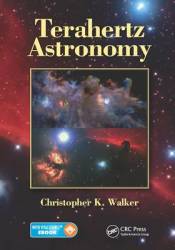

A Powerful Window into Cosmic Evolution Terahertz (THz) observations of interstellar atoms, molecules, and dust serve as powerful probes of the conditions within the interstellar medium that permeates our galaxy, providing insights into the origins of stars, planets, galaxies, and the Universe. Taking a cross-disciplinary approach to the subject, Terahertz Astronomy explores THz astrophysics and the technologies that make this rapidly evolving field possible.
The first four chapters of the book discuss the origin and interpretation of THz light in astrophysical sources. The remaining five chapters present an overview of the technologies used to collect and detect THz light. Every chapter contains worked-out examples and exercises. The author explains each topic as intuitively as possible and includes the equations needed for real-life astrophysical applications.
In just a few years, the number of active THz researchers has substantially grown due to increased interest in terrestrial remote sensing at THz frequencies. This book provides researchers with both the background science and technology to interpret THz observations and design, build, and deploy THz astronomical instrumentation.
Review: ... a wonderful book, combining an insightful overview of the interstellar medium with a description of the most important techniques used to study this component of galaxies and how new stars form. It's particularly timely, with the availability of powerful new tools, including the ALMA array, the SOFIA airborne observatory, and a range of planned and proposed suborbital and space missions in the terahertz range. -Paul F.
Goldsmith, Jet Propulsion Laboratory, California Institute of Technology and Herschel Space Observatory This valuable and well-written textbook by Professor Christopher Walker helps to fill a gap in the literature describing the interstellar medium at terahertz frequencies. There are very few textbooks that discuss the medium from the observer's point of view, showing how to determine its physical parameters from the output of the detectors.
Also discussed are the operations of mixer and bolometer detectors. -Thomas G. Phillips, John D. MacArthur Professor of Physics Emeritus, California Institute of Technology ... a fundamental source for astronomers and engineers who wish to understand the physical principles and detection techniques. -Jonathan Williams, University of Hawaii Walker's book is incredibly timely: it introduces the basics of terahertz data but also explains the instrumentation at the level all observers need to know, and does so in friendly but, most importantly, crystal-clear prose. -George H.
Rieke, Regents' Professor of Astronomy, University of Arizona
 Related Products
Loading similar products...

Stay informed about the best deals and price drops. Choose which notifications you'd like to receive from PriceCheck.


